
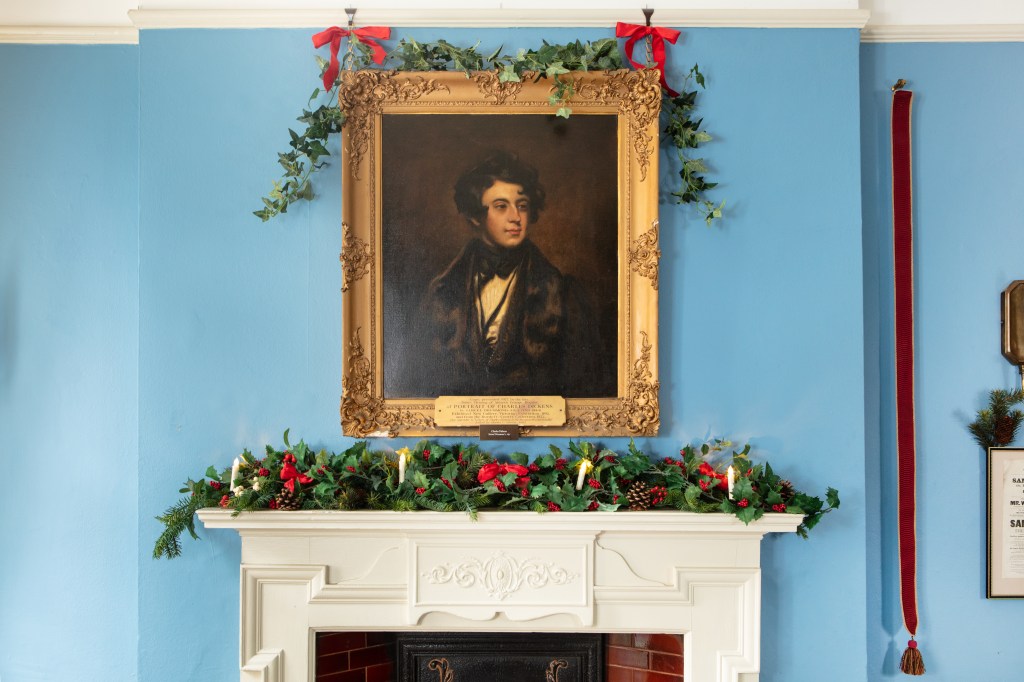
Portrait of Charles Dickens at the Dickens Museum, London.
Charles Dickens is often credited as the man who invented modern Christmas. His immortal novella, ‘A Christmas Carol,’ is one of the most famous works of English literature. Indeed, even in his lifetime, Dickens was so powerfully connected with the festive season, as news broke in 1870, that the great author was dead, a little girl was overheard in Covent Garden market exclaiming, “Dickens dead? Does that mean Father Christmas will die too?”
But his incredible association with Christmas does not just come from the one book. From the very beginnings of his literary career in 1833 to his final novel in 1870, Dickens continually utilised the festive season as a means to highlight his depth, poignancy and call for change. These writings are utterly beautiful, often deeply emotional, and they capture a real sense of what it means to be human!
There are countless quotes to choose from, but here are 10 of my favourites.
1.
There seems a magic in the very name of Christmas.
– A Christmas Dinner, 1835 (Sketches by Boz).
Not so well-known today, Sketches by Boz was a series of short pieces published between 1833 and 1836, when Dickens was in the earliest stages of his writing career. They are not stories, but rather they are little description pieces, which detail the city of London and its inhabitants. ‘A Christmas Dinner’ came out in 1835 and beautifully describes the excitement, joy and escapism offered by the festive period. As an interesting historical note, Dickens is often credited with ‘inventing’ Christmas through ‘A Christmas Carol’ which was published in 1843. But here we have a description of what is clearly an already established celebration a full eight years before his most famous novella was released.
2.
Would that Christmas lasted the whole year through.
– A Christmas Dinner, 1835 (Sketches by Boz).
Move over Whizzard, Charles Dickens was wishing it was Christmas every day long before the 1973 pop hit. Dickens always portrayed Christmas as time when people are that little more charitable and loving towards their fellow humanity, and lamented that, come January, we often revert to our selfish ways.
3.
There are people who will tell you that Christmas is not to them what it used to be; that each succeeding Christmas has found some cherished hope, or happy prospect of the year before dimmed or passed away… never heed such dismal reminiscences.
– A Christmas Dinner, 1835.
I adore this quote, though it is a little longer. It can easily feel as though Christmas loses some of its magic as we get older, but, as Dickens writes here, this is a self-inflicted misery! To Dickens, Christmas was always a time for joy, love and sharing – but also a time to remind ourselves that our hopes and dreams are important. No matter what challenges and difficulties we face, Christmas offers us a moment to pause, to reconnect with our loved ones and to rediscover our childlike wonder.
4.
Reflect upon your present blessings – of which every man has many – not on your past misfortunes, of which all men have some. Fill your glass again, with a merry face and contented heart… your Christmas shall be merry, and your new year a happy one!
– A Christmas Dinner, 1835.
This is one of my all-time favourite Dickens quotes. It is a sad reality that most of us endure periods of difficulties and challenges. Dickens himself battled depression throughout his life, though he would never have used that word. But most of us, if we are honest with ourselves, have far more blessings than we do misfortunes. Friends, family, health, books, pets, faith, or perhaps simply the fact that you are alive, there are always reasons to be grateful and it is in holding onto these good things that we are strengthened to endure the bad.
Plus, Dickens instructs us to fill our glasses again… who am I to refuse?
5.
How many families, whose members have been dispersed and scattered far and wide, in the restless struggles of life, are then reunited, and meet once again in that happy state of companionship and mutual goodwill, which is a source of such pure and unalloyed delight; and one so incompatible with the cares and sorrows of the world.
– The Pickwick Papers, 1836.
As someone who has lived away from my family for 10 years, this one really hits home. There is an unspoken beauty of being reunited with your loved ones, and it absolutely is the antidote to the darkness of our own times.
6.
How many old recollections, and how many dormant sympathies, does Christmas time awaken!
– The Pickwick Papers, 1836.
Christmas is a time for nostalgia. Every year you can’t help but think about childhood Christmases, family traditions and sheer joyful memories which you mostly forget about through the rest of the year. There is a joy in nostalgia, and Dickens really draws upon that here.
7.
He was conscious of a thousand odours floating in the air, each one connected with a thousand thoughts, and hopes, and joys, and cares long, long forgotten.
– A Christmas Carol, 1843.
I know I began this blog by saying I wanted to focus on more than ‘A Christmas Carol,’ but this is one of the greatest lines in English literature. Nothing captures the sense of childhood memories more beautifully, powerfully and romantically than this line from the famous novella.
8.
Welcome, old projects and old loves, however fleeting, to your nooks among the steadier lights that burn around us. Welcome, all that was ever real to our hearts; and for the earnestness that made you real, thanks to Heaven!
– Christmas As We Get Older, 1851.
In ‘Christmas As We Get Older,’ a short piece written in 1851, Dickens utilises the image of a Christmas Tree as a simile for memory, reflecting on how each ‘ornament’ reflects a different part of life. He calls upon the reader to welcome all to the tree of memory, capturing his strong belief that through accepting and acknowledging our past – even the difficult, or painful past – we can become kinder, and more compassionate. This message was taken further in an earlier work of 1848 ‘The Haunted Man’ in which the grieving protagonist, Redlaw, is redeemed by the warmth and acceptance of Millie, who has endured unbearable pain, but whom has been strengthened through acceptance.
9.
Oh, now all common things become uncommon and enchanted to me.
– The Christmas Tree, 1850.
How wonderful a thought, and such a true one! There is nothing extraordinary about a roast dinner, a present or a decorative ornament. Nothing extraordinary about a glass of wine, or a game, or a cup of tea with your mother. But there is something about Christmas which seems to transcend normality, making these simple, ordinary actions seem magical and wonderous. The laughter of loved ones, the joy of being together, the delight of the bright lights in the neighbourhood, all these things seem different in our memory, more important, and as Dickens writes, enchanting.
10.
Lord keep my Memory green.
– The Haunted Man, 1848.
Okay, if you haven’t read ‘The Haunted Man,’ drop what you are doing and read it immediately. You can even access a free version online. It is one of the most powerful stories Dickens ever wrote, especially relevant to people who are carrying grief or whom are suffering over the festive period. The reason I love this quote so much is precisely because it captures Dickens’s eternal belief that suffering, though at times unbearable, is essential for the growth of compassion. When Dickens asks for his memory to be kept ‘green,’ i.e. fresh, he doesn’t just mean the joy and the laughter, important though those things are. He also means the pain, the sorrow, the heartbreak of loss. Without sorrow and pain there can be little love. And love, to Dickens and indeed, to many people around the world, is the single most important thing in any of our lives.
There are countless more quotes to choose from, its really not hard to see why Dickens has come to be so powerfully associated with the Christmas period.
But before you go, let’s end on what is probably the most famous of them all – and indeed, a very apt one.
God bless us, everyone!

Leave a comment